IGNOU MBA Project Tutorial (Complete Step-by-Step Guide – MMPP-001)
The IGNOU MBA Project (MMPP-001) is one of the most important academic requirements for students enrolled in MBA, MBAFM, MBAHM, MBAMM, MBAOM and MBF programmes under IGNOU. Unlike theory-based examinations, the IGNOU MBA Project allows students to apply management concepts to real organisational or industry-related problems. Through this project, students demonstrate their ability to conduct research, analyse data, and present findings in a structured and academic manner.
For many students, the IGNOU MBA Project becomes challenging because the process involves several stages such as topic selection, synopsis approval, guide selection, data collection, report writing, and final submission. Each stage must strictly follow IGNOU guidelines, and even small mistakes can lead to delays or rejection. This step-by-step guide explains the complete IGNOU MBA Project process in a clear, practical, and student-friendly way so that students from all MBA streams can complete their project with confidence.
Understanding the Structure of the IGNOU MBA Project
Before starting your IGNOU MBA Project, it is essential to understand its structure. The project is divided into two main components, and both must be completed in sequence as per IGNOU rules.
IGNOU MBA Project Support – All Specializations
We provide IGNOU MBA project guidance and reference PDF reports prepared according to the latest IGNOU guidelines. These materials are available strictly for academic reference and support purposes.
Specializations covered include MBA (NEW/MBAOL), MBF, MBAHM, MBAFM, MBAOM, MBAMM, MBACN, MBALS, MBAABM, and MBAHCHM.
Contact for IGNOU MBA Project Assistance
For support with topic selection, synopsis, project writing, formatting, or submission guidance, feel free to contact us for personalised assistance.
📞 Phone: 9891268050
Project Proposal (Synopsis)
The Project Proposal, commonly known as the Synopsis, is the first formal step of the IGNOU MBA Project. It is a short but focused document that clearly explains the overall plan of your study. In the synopsis, you are required to mention:
-
The project topic you want to study
-
The importance and relevance of the selected topic
-
The objectives of the study
-
The research methodology you plan to use
The synopsis acts as the blueprint of your IGNOU MBA Project. IGNOU evaluates the proposal to ensure that the topic is suitable for the MBA programme, feasible within the given time, and academically sound. Without official synopsis approval, students are not allowed to begin data collection or project report writing.
Project Report
The Project Report is the final document submitted to IGNOU for evaluation. It is generally 50–60 pages, double-spaced, and written in formal academic language. The report presents your complete research work and usually includes:
-
Introduction and background of the study
-
Research methodology
-
Data analysis and interpretation
-
Findings and conclusions
-
Practical recommendations
This document plays a major role in determining the final marks of the IGNOU MBA Project (MMPP-001) and is compulsory for successful completion of the MBA, MBAFM, MBAHM, MBAMM, MBAOM and MBF programmes.
Part 1: Starting the IGNOU MBA Project (Before Approval)
Every IGNOU MBA Project starts with a common question in the student’s mind: What should I choose as my project topic?
The stage before synopsis approval mainly involves three important activities:
-
Selecting a suitable project topic
-
Choosing an eligible project guide
-
Preparing a clear and well-structured synopsis
Step 1: Choosing the Right Topic for IGNOU MBA Project
Topic selection is the foundation of the entire IGNOU MBA Project. A well-chosen topic makes the project easier, while a poorly chosen topic can cause delays or rejection.
The most important rule is that your project topic must be directly related to your MBA specialisation.
Students from different specialisations usually choose topics such as:
Marketing specialisation
-
Consumer buying behaviour
-
Digital marketing strategies
-
Advertising effectiveness
-
Brand awareness and customer satisfaction
Finance specialisation
-
Financial performance analysis
-
Investment decision-making
-
Risk management practices
-
Working capital management
Human Resource Management
-
Employee motivation and engagement
-
Training and development practices
-
Performance appraisal systems
-
Employee retention and job satisfaction
Operations Management
-
Supply chain efficiency
-
Logistics and distribution systems
-
Project management practices
-
Process improvement techniques
Your IGNOU MBA Project title should always be specific and focused. For example, a title like “A Study of Business Management” is too broad, whereas “Impact of Training and Development on Employee Productivity at ABC Pvt. Ltd.” clearly defines the scope.
IGNOU generally allows the following types of studies:
-
Case study of a single organisation
-
Comparative study of two or more organisations
-
Field or survey-based study using primary data
Students should always choose a topic where data collection is realistic and possible.
100+ IGNOU MBA Project Topics with Brief Explanation (MMPP-001)

Step 2: Finding the Right Project Guide
Once the topic is finalised, the next important step in the IGNOU MBA Project is selecting a Project Guide. The guide plays a crucial role throughout the project journey.
A project guide helps students by:
-
Providing academic guidance
-
Reviewing drafts and progress
-
Ensuring IGNOU guidelines are followed
-
Keeping the project aligned with academic standards
As per IGNOU rules, a project guide can be:
-
An IGNOU faculty member
-
An approved IGNOU MBA academic counsellor
-
A management faculty member with at least 5 years of postgraduate teaching experience
-
A professional with a Master’s degree in Management (or related field) and at least 5 years of relevant experience
Important points to remember:
-
One guide can supervise a maximum of five students
-
Guide’s signed bio-data must be attached with the synopsis (if not an IGNOU counsellor)
Students should select a guide who is approachable and willing to provide feedback, not just someone who signs documents.
Step 3: Preparing the IGNOU MBA Project Synopsis
The synopsis is the document that officially introduces your IGNOU MBA Project to IGNOU. Without an approved synopsis, you cannot move to the main project work.
A good synopsis generally includes:
-
Introduction and background of the study
-
Rationale for selecting the topic
-
Clear and measurable objectives
-
Research methodology
-
Limitations of the study
The research methodology section explains how the study will be conducted. It usually covers:
-
Research design (case study, survey, comparative study)
-
Data sources
-
Primary data (questionnaires, interviews, surveys)
-
Secondary data (books, journals, reports, websites)
-
-
Sample size and sampling method
-
Tools for analysis (Excel, SPSS, percentages, correlation, regression)
Along with the synopsis, students must attach:
-
Project Proposal Proforma signed by student and guide
-
Guide’s signed bio-data (if applicable)
Part 2: After Approval – Completing the IGNOU MBA Project
Once the synopsis is approved, students can officially begin data collection and report writing. Approval is the green signal to move ahead with the main IGNOU MBA Project work.
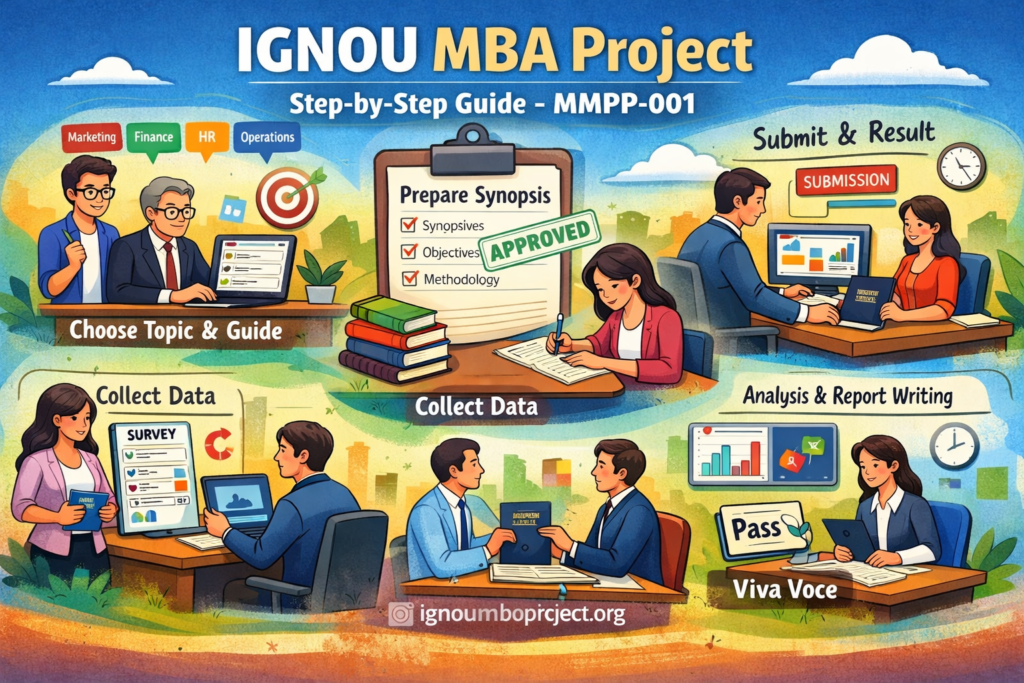
Step 4: Data Collection for IGNOU MBA Project
Data collection is one of the most important stages of the IGNOU MBA Project. Depending on the type of study, students collect two types of data.
Primary data, which is collected directly by the student, may include:
-
Questionnaires
-
Interviews
-
Surveys
-
Observations
Secondary data, which already exists, may include:
-
Annual reports
-
Books and journals
-
Government publications
-
Financial statements
-
Trusted websites
Secondary data helps strengthen the literature review and supports primary findings.
Step 5: Data Analysis and Interpretation
After data collection, the next step is analysis. This is where raw data is converted into meaningful insights.
Students commonly use:
-
MS Excel for charts and percentages
-
SPSS for advanced statistical analysis
-
Techniques such as averages, correlation, regression, and chi-square tests
The key is to interpret the results, not just present numbers. Every finding should be linked back to the objectives of the IGNOU MBA Project.
Step 6: Writing the IGNOU MBA Project Report
The final IGNOU MBA Project Report should be around 50–60 pages, double-spaced, and within 18,000 words. The report generally includes:
-
Introduction and literature review
-
Research methodology
-
Results and discussion
-
Summary and conclusion
-
Recommendations
-
Limitations
-
References and annexures
Step 7: Submission and Result
ODL students submit a bound hard copy to IGNOU, while Online MBA students upload the report through the LMS portal. After submission, IGNOU issues a Project Report Number (PR.No.), which should be kept safely.
Results are declared based on submission cycle:
-
December–May submissions → June TEE
-
June–November submissions → December TEE
In some cases, IGNOU may also conduct a viva-voce.
Part 4: Useful Tips, FAQs, and Final Advice
Practical Tips to Make Your IGNOU MBA Project Easier
-
Start early; do not wait for the last semester
-
Choose a manageable and realistic topic
-
Stay in regular contact with your guide
-
Use tools like Excel and Google Docs
-
Support findings with secondary research
-
Write gradually instead of rushing at the end
Suggested timeline:
-
Week 1–2: Topic and synopsis finalisation
-
Week 3–6: Data collection
-
Week 7–10: Data analysis
-
Week 11–12: Report writing
Common Reasons Why IGNOU MBA Projects Get Rejected
-
Vague or overly broad topics
-
Unclear or non-measurable objectives
-
Ineligible project guide
-
High plagiarism levels
-
Missing documents or signatures
Avoiding these mistakes greatly improves approval chances.
Why Trust Us for Your IGNOU MBA Project?
We understand that the IGNOU MBA Project (MMPP-001) plays a crucial role in completing your MBA degree. Our approach is designed to support students at every step while strictly following the latest IGNOU guidelines.
Customized Support: We provide one-on-one assistance tailored to your specific project requirements and MBA specialisation. Every project is handled individually to ensure it aligns perfectly with IGNOU MBA Project guidelines and evaluation standards.
Expert Mentorship: Our team consists of experienced academic professionals with strong expertise in management studies and research methodology. We offer meaningful insights, editorial feedback, and step-by-step guidance throughout your IGNOU MBA Project journey.
On-Time Project Delivery:We respect your academic deadlines. Our structured workflow ensures that your project synopsis and final report are completed and delivered well within the stipulated IGNOU timelines, eliminating last-minute pressure.
Approval-Focused Approach:Quality and compliance are our priorities. We ensure that your IGNOU MBA Project proposal and report meet university standards and are prepared in a way that supports smooth approval. Free revisions are provided until you are fully satisfied.
Affordable and Student-Friendly
We believe quality academic support should be accessible. Our services are priced reasonably to suit student budgets, without compromising on accuracy, originality, or academic quality.
Contact for IGNOU MBA Project Assistance
If you need support at any stage of your IGNOU MBA Project (MMPP-001)—whether it is topic selection, synopsis preparation, project report writing, formatting, or submission guidance—you can get in touch with us for personalised assistance.
📞 Phone: 9891268050
We provide guidance tailored to your MBA specialisation and individual project requirements, helping you complete your project smoothly and confidently.
Frequently Asked Questions (FAQs)
Q. How should I choose a topic for my IGNOU MBA Project?
You should select a topic that is directly related to your MBA specialisation. Depending on your interest and access to data, you may choose a case study, comparative study, or field/survey-based study. A practical and manageable topic is always recommended.
Q. Who can act as my project guide?
Your project guide must be either an IGNOU-approved guide or a management professional/faculty member who meets IGNOU’s eligibility criteria in terms of qualification and experience.
Q. How do I submit my project synopsis?
For ODL students, the synopsis is submitted to the Regional Centre. For MBA (Online) students, the synopsis must be uploaded through the LMS Portal only.
Q. How long does synopsis approval usually take?
The approval process generally takes two to three months, depending on the submission time and evaluation process.
Q. What happens if my synopsis is rejected?
If your synopsis is not approved, IGNOU provides feedback. You can revise the proposal as suggested and resubmit it with a fresh Proforma and required documents.
Q. How long should the IGNOU MBA Project Report be?
The project report is usually 50–60 pages, double-spaced, and should not exceed 18,000 words, as per IGNOU guidelines.
Q. Is it mandatory to attach the approved synopsis with the final report?
Yes, the approved synopsis, along with other mandatory documents, must be bound inside the final project report at the time of submission.
Q. Can IGNOU conduct a viva-voce for the MBA project?
Yes, in some cases IGNOU may conduct a viva-voce based on the evaluator’s recommendation to assess your understanding of the project.
Q. What are the plagiarism rules for the IGNOU MBA Project?
The project must be completely original. Copying content from the internet or other sources without proper citation may lead to rejection of the project. Always write in your own words and cite references correctly.